In case anyone missed it, Apple revealed iPhone 4 yesterday along with all its improvements. There is a lot of coverage out there on it so I’ll just concentrate on my reactions to the device.

The new iPhone is thinner and made with glass on both the top and bottom. In between the two pieces of glass is a stainless steel bezel which also doubles as the antenna so in effect the antenna has been moved to the outside of the phone. Unfortunately, it does nothing to improve reception on the Verizon network.

Apple has also (finally) decided that iPhone OS isn’t a fitting name for their devices and instead of renamed it to iOS. It really should have been called this from the beginning because the iPod touch came out immediately after the iPhone and the iPad was already in the works. In fact, in a recent interview (D8) Jobs revealed that the iPad was in development before the iPhone and that the iPhone was created based from the iPad idea. At any rate, this is the first time I think of where Apple has renamed such a major product at this stage in the game. I always figured Microsoft was the only company that couldn’t stick with a name.

iPhone 4 also finally gets the forward facing camera everyone has been clamoring for and frankly, I just don’t see this being as big a deal as everyone claims. Of course, a front facing camera is useless unless you have a reason to use it and Apple’s reason is the new FaceTime app. FaceTime is really nothing more than iChat for iPhone but if you are to believe what you hear in Apple’s promotional video on their site it’s the second coming of Christ. I’m an Apple guy but they talk up FaceTime as if we haven’t been doing video chatting for over ten years. Am I the only one who remembers the black and white quikcam?. I just don’t see it catching on today any more than it has prior to iPhone 4.

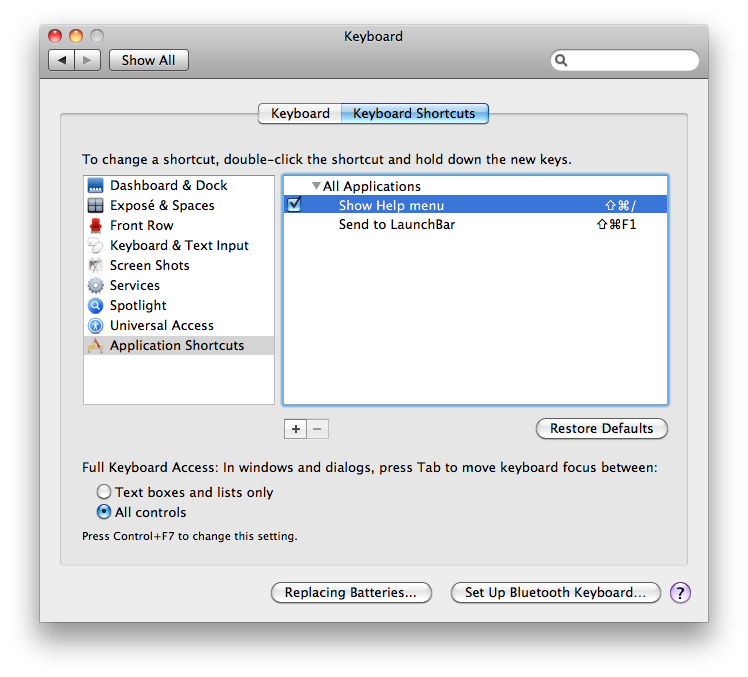
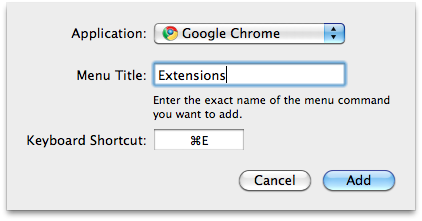
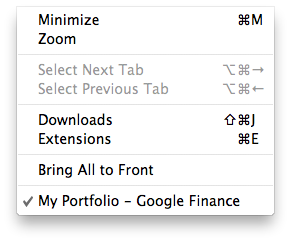
It’s possible to create a keyboard shortcut to nearly any menu item for any application. For example, lets say you’d like to create a keyboard shortcut to show extensions in Google Chrome.

To do so start System Preferences from the Apple menu in the upper left. Next, click the keyboard option and then click the Keyboard Shortcuts button.

Click the plus to add a new keyboard shortcut. Search for the application, enter in the name of the menu item, the keyboard shortcut you want to assign and click Add.

The shortcut will now have been added. You may need to close and reopen the application before it appears.

In at least Snow Leopard, and possibly older versions, hot corners are nearly always hot. For example, if you setup a hot corner to show the desktop you can drag a file from a finder window to that hot corner and cause it to fire allowing you to place a file on the desktop or a folder on the desktop easily.

Last week I helped someone rescue their computer. The striped disk set had gone wonky and would only occasionally boot properly. If it booted at all it would run fine, but getting it to boot was the tricky part. They wanted me to fix the issue and as long as I was doing so, upgrade the system to Windows 7.

After some effort, I got the computer to boot and promptly created an image of it using my favorite disk imaging software. I then broke the raid set and used the one drive that was still good to install Windows 7. Once installed I copied the appropriate data from the old Vista system on to the new Windows 7 system. All seemed well until I got an email claiming the computer wouldn’t download files or play flash videos.

While attempting to download a file they’d get the following error.

Internet Explorer cannot download from
Internet Explorer was not able to open the Internet site. The requested site
is either unavailable or cannot be found. Please try again later.

After much trial and error I found the solution. Rename the Temp directory located at %userprofile%\AppData\Local. Once this was done IE was able to download files and play flash videos once again. I’m not sure what the real issue was but this fixed it.

Apple throws Adobe a bone — on the Mac: “

Filed under:

Adobe’s Flash Player has never performed as well in Mac OS X as it does on Windows-running PCs. The traditionally poor performance of Adobe’s plugin on the Mac has led many iPhone and iPad users to support Apple’s decision to keep Flash off of its mobile devices. While the upcoming Flash 10.1 does boast some significant performance improvements over its predecessors, the performance is still pretty terrible compared to h.264, which has access to hardware-accelerated video decoding via the GPUs in Macs.

Adobe’s stance has long been to blame Apple for the poor performance of Flash on the Mac, citing Apple’s unwillingness to allow third-party developers access to APIs necessary for hardware-accelerated video. Adobe no longer has that excuse to fall back upon: Apple posted a technical note back in late March that removes this restriction and allows third-party developers access to hardware-acceleration APIs for h.264 decoding in compatible GPUs. The technical note describes ‘a C programming interface providing low-level access to the H.264 decoding capabilities of compatible GPUs’ — meaning only the latest Mac GPUs, the NVIDIA GeForce 9400M, GeForce 320M and GeForce GT 330M. ‘It is intended for use by advanced developers who specifically need hardware accelerated decode of video frames,’ the note continues.

So there you have it, Adobe. The one thing that’s supposedly been holding you back from getting decent Flash performance on the Mac is now gone. Now that Apple has removed this ‘stumbling block’ and you’re unfettered by Apple’s restrictions, the onus is on you to prove that you can deliver a well-crafted Flash plugin for the Mac — preferably one that doesn’t crash constantly or send my fans into a cyclone any time I try to watch full-screen Flash videos.

It will be interesting to see how Adobe responds to this. If Adobe takes advantage of the hardware-acceleration APIs, how much improvement Flash’s performance sees as a result will settle the debate once and for all over who’s been at fault for Flash’s subpar performance on the Mac. Even if Flash sees substantial performance on the Mac as a result of this move, though, there’s probably no chance that Apple will relent on its stance regarding Flash on iPhone OS.

[Via MacRumors]

TUAWApple throws Adobe a bone — on the Mac originally appeared on The Unofficial Apple Weblog (TUAW) on Thu, 22 Apr 2010 19:00:00 EST. Please see our terms for use of feeds.

Read | Permalink | Email this | Comments

(Via The Unofficial Apple Weblog (TUAW).)